
Dutch academic hospitals Mainbanner

Future-proof workplaces for Dutch university hospitals.

Healthcare demand is increasing—and so is the shortage of staff.


It’s no secret that the Dutch healthcare system is under pressure. An ageing population is driving up demand, while the shortage of healthcare professionals continues to grow. University hospitals face a unique challenge as they deliver complex care, train future professionals and conduct scientific research, all of which places high demands not only on care teams, but also on the IT departments that support them. 

Modern patient care depends on reliable, user-friendly IT, but the pressure on IT departments is mounting with more systems and more devices to manage, yet often with the same or even fewer people and resources. So how do you stay on top of that complexity? And how do you ensure that healthcare professionals always have access to a workplace they can rely on? 

The biggest IT challenges facing Dutch hospitals.


The role of IT departments in healthcare is becoming increasingly strategic. At the same time, hardware and infrastructure are essential for ensuring continuity in care and driving innovation—yet they come with significant challenges.

ARP exclamation symbol

ICT spending at university hospitals is going up from an average of 5.7% to 6% of revenue. Costs for licences, management and support continue to increase.

ARP exclamation symbol

Whereas hardware investments were traditionally made from capital budgets, university hospitals are increasingly shifting towards operational budgets (from CAPEX to OPEX). This offers greater flexibility, though it also calls for new contract models and a different approach to governance.

ARP exclamation symbol

Hospitals are no longer relying on a single model—they’re opting for hybrid infrastructures.. On-premises solutions are being combined with cloud services, with security, compliance and performance taking centre stage.

ARP exclamation symbol

The workplace itself is evolving. The number of desktop PCs is declining in favour of thin clients and mobile devices. Tablets, smartphones and scanners have become indispensable in hospitals, leading to a wider variety of device types, user profiles and usage scenarios.
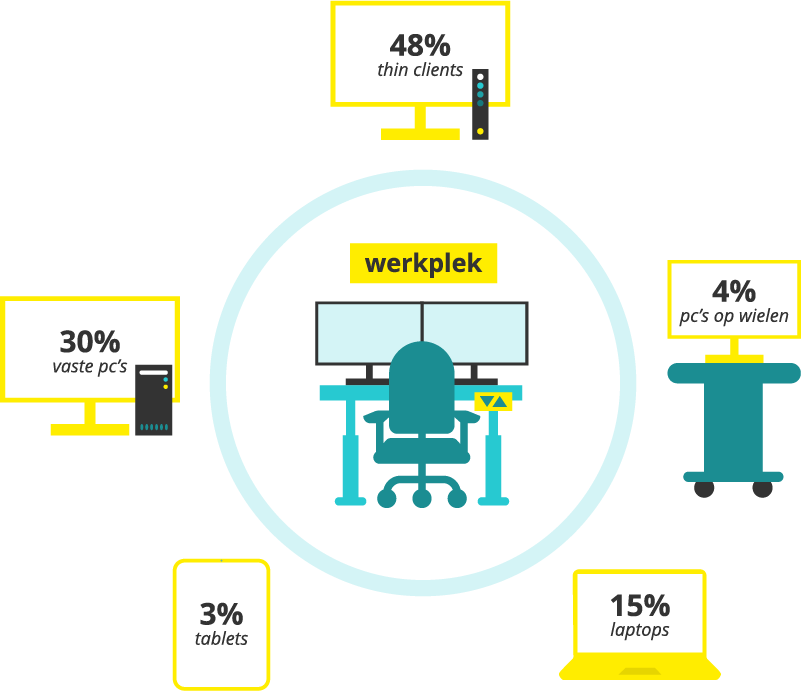

ARP Workplace

For your IT department, this means more devices to manage, more contracts to oversee and more critical integrations to monitor. That not only increases the complexity of day-to-day operations, but also raises the risk of outages and vulnerabilities. The more systems and suppliers involved, the greater the chance that updates won’t align properly—or that security gaps may emerge.

1M&I Partners | ICT Benchmark Ziekenhuizen 2024.


Reducing pressure on your service desk.


Quite simply, as a healthcare professional, you expect your workplace to work—whether you’re a doctor logging in on a thin client at the outpatient clinic, a nurse using a tablet at the bedside, or a researcher analysing data from home.

The service desk is often the first point of contact when a device fails, and this is precisely where the pressure is increasing:

Servicedesk ARP icon

More calls due to the growing number of devices and applications

Danger triangle ARP icon

More complex incidents caused by hybrid environments

Timemanagement ARP icon

Limited capacity to guarantee fast response times around the clock

At many university hospitals, this situation is no longer sustainable. Hiring additional staff isn’t always feasible or affordable, but one possible solution is Device as a Service (DaaS).

With DaaS, you not only outsource the delivery and management of devices, but the entire lifecycle—including installation, support, updates and ultimately sustainable reuse or recycling. DaaS relieves the burden on your service desk, ensures predictable costs and a better experience for end users.

AI calls for modern workplaces.


AI is no longer a future concept—it’s already transforming the way we work. In healthcare, it promises smarter processes, advanced data analysis and better support for clinical decision-making. University hospitals are often ahead of the curve, as innovation is part of their academic and societal mission. 

This shift, however, places new demands on the workplace. The arrival of Copilot+ PC’s and other AI-optimised hardware is signalling a new phase, but to move from experimentation to real-world implementation, healthcare organisations need modern, future-ready workplaces.


Consider the following questions:

ARP question symbol

How can we ensure that new technologies are secure, reliable and scalable?

ARP question symbol

Is our IT infrastructure—and our cloud environment—ready to support AI?

ARP question symbol

Are our workplaces equipped for AI implementation?

ARP secures the entire workplace lifecycle.

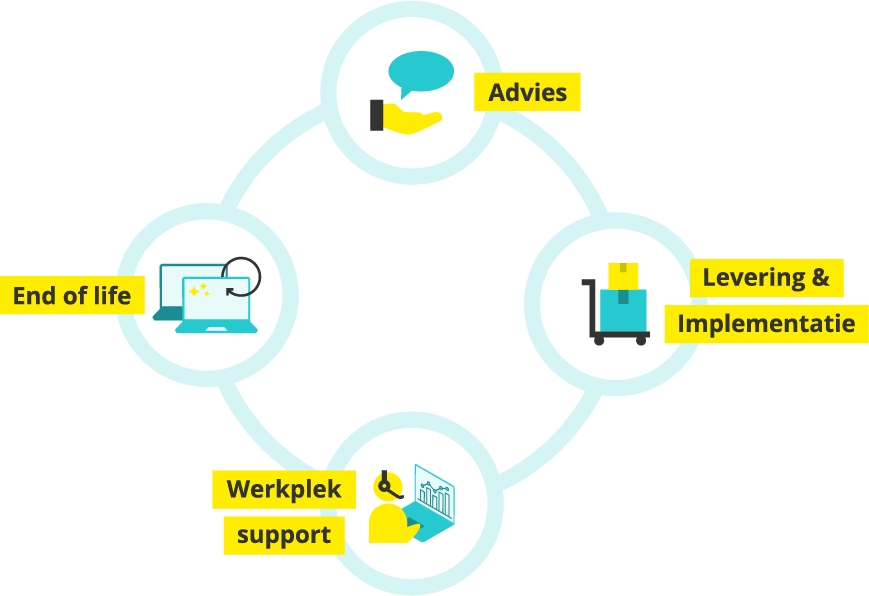
As a university hospital, you need an IT partner who offers more than just hardware. You need someone who understands that a hospital workplace is far from standard—and who can take full responsibility for every stage of the workplace lifecycle: from expert advice and delivery to support and sustainable reuse.

That’s exactly where ARP comes in. We’ve been working closely with hospitals and healthcare institutions across the Netherlands for many years and understand the unique challenges of the healthcare sector and the critical role IT plays in addressing them. ARP partners with leading vendors including Microsoft, Lenovo, Apple, Samsung and HP.


Our strength? We take ownership of the entire workplace lifecycle.

This means we don’t just deliver reliable workplaces—we help hospitals manage costs more predictably and ease the pressure on their IT departments.

ARP check symbol

Consultancy and design: what does your healthcare organisation really need?

ARP check symbol

Fast, reliable and scalable delivery and implementation.

ARP check symbol

Reduced pressure on your service desk and guaranteed uptime.

ARP check symbol

Lifecycle management: updating, refreshing and sustainably retiring hardware.
Ready for the next step?

The challenges in healthcare are significant—which is precisely why IT plays such a crucial role. Future-proof workplaces make a real difference for end users, patients and the continuity of your hospital. 


  • For IT managers, this means less pressure on the service desk and greater control over the workplace lifecycle.
  • For procurement teams, it offers transparent contract models and the flexibility to shift from CAPEX to OPEX.
  • For contract managers, it provides confidence in a trusted IT partner—one with deep knowledge of the healthcare sector and a proven track record with major clients.
Want to know more?

Curious how ARP can support your hospital with end-to-end workplace lifecycle management? Get in touch to explore the possibilities. Our experts will be happy to support you.

* Required fields

Please read our Privacy Policy for information on how we process your data and protect your rights as a data subject.

By submitting this form you agree that ARP Nederland B.V. may process your personal details in line with our Privacy Policy. You also agree that we may contact you by phone about our products and services.